
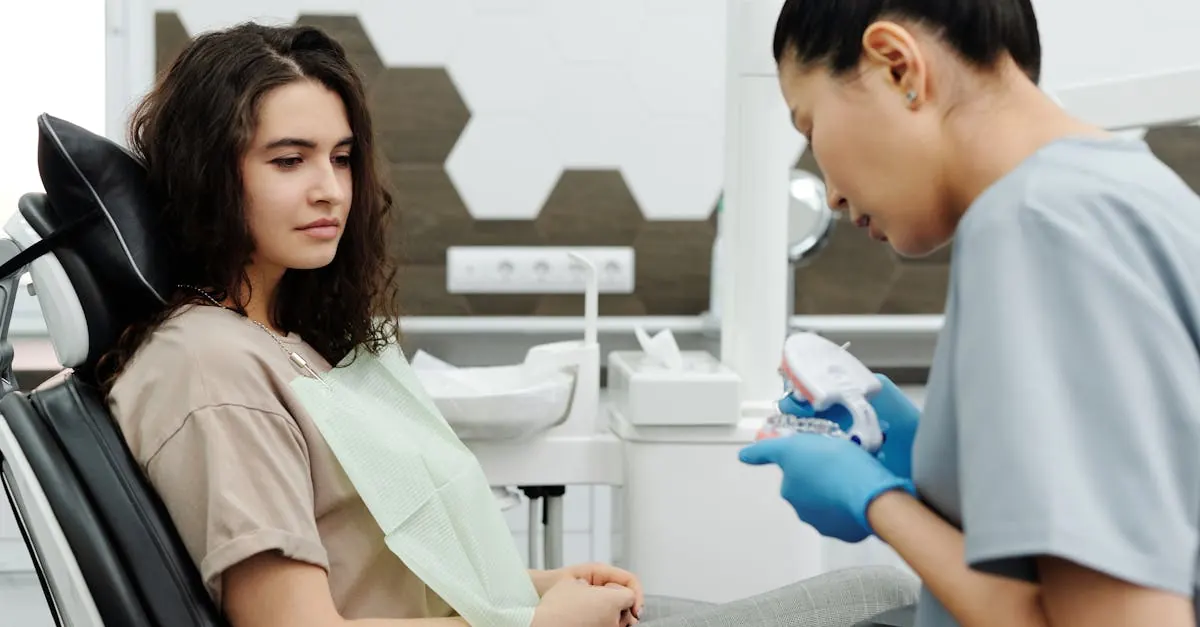
If a tooth breaks, you have time, call us first. Most broken teeth are urgent, not emergency-room emergencies, and we can usually restore them in a single visit during clinical hours. The next hour matters less than getting the right next step.
Here is the calm, practical version of what to do.
First, slow down
A broken tooth feels alarming. The sharp edge against your tongue, the surprise of biting down on something hard, the small piece in your mouth that wasn't there a second ago, all of it raises adrenaline. None of it requires you to panic.
Take a breath. Sit down. Rinse your mouth gently with warm water so you can actually see what happened. Most broken teeth are not life-threatening dental emergencies, they are urgent, which means you have a window to think and call.
The five most common ways teeth break
So you understand what likely happened:
1. Biting down on something unexpected. A popcorn kernel, an olive pit, a small bone in a piece of chicken. The crack usually runs through an existing filling.
2. An old filling that finally gave out. Amalgam fillings from twenty or thirty years ago eventually fatigue. The tooth around them weakens, and a normal bite finishes the job.
3. Grinding (bruxism). Long-term grinding, often during sleep, often without your knowledge, slowly thins the cusps of your back teeth until one cracks.
4. A fall or sports impact. A direct hit to the front teeth, common in any sport without a mouthguard.
5. Decay you didn't know about. A cavity hollows out the tooth from the inside, and a perfectly normal bite suddenly collapses it.
Knowing which one is yours doesn't change the next step, but it helps Dr. Agrawal plan the right restoration.
Save the piece if you can
If the broken-off piece of tooth is still in your mouth or pocket, save it. Drop it in a small container with milk or saliva, not water. The fluid keeps the piece viable long enough for us to evaluate whether it can be bonded back into place.
Re-bonding is not always possible, and it is not always the best long-term answer even when it is. But for a clean break on a front tooth, in particular, it is sometimes the simplest and most natural-looking fix.
Even if the piece is not re-bondable, bring it. Looking at it tells us about the angle of the fracture and how deep it goes.
Rinse, compress, watch for pain
Rinse your mouth gently with warm water (not cold, cold water on an exposed tooth nerve hurts). If your gum or lip is bleeding, fold a clean piece of gauze (or a damp tea bag, the tannins help clotting) over the area and bite down for ten full minutes. Do not check it every minute; you'll restart the clotting.
For pain, over-the-counter ibuprofen is usually the best first choice. For most adults, 400 to 600 mg every six hours reduces both pain and inflammation. If you cannot take ibuprofen, acetaminophen (Tylenol) at 500 to 1,000 mg every six hours is the alternative. Do not exceed the package directions, and do not put aspirin directly on the gum, it burns the tissue.
If a sharp edge is cutting your tongue or cheek, a piece of sugar-free chewing gum or a small bit of dental wax (sold at most pharmacies for a few dollars) makes a temporary buffer. Press it gently over the sharp edge.
When to call us, and when (rarely) to go to the ER
For almost every broken tooth, call our office at 540-337-6004 before doing anything else. We hold same-day emergency slots specifically for cracked and broken teeth, and we can usually have the tooth restored, bonded, or temporarily crowned in a single appointment.
The honest comparison: the emergency room can stop bleeding and prescribe a painkiller. They cannot restore your tooth. A dental crown (a protective cap that fits over a damaged tooth and lets us save it rather than pull it) requires a digital scan of your mouth and a tooth-colored restoration the ER does not have. If you go to the ER, you will end up calling us the next morning anyway, and you will have paid an ER bill.
Three situations do call for the ER first:
- Uncontrolled bleeding that does not slow after 20 minutes of firm gauze pressure. Rare with a broken tooth alone; more common with an associated lip or tongue injury.
- A serious head injury alongside the broken tooth. If you were knocked unconscious or are having trouble seeing or speaking, the head injury is the priority.
- Severe facial swelling that involves the eye or makes it hard to breathe. This suggests an infection that has spread, uncommon, but a true emergency.
For everything else, call us first.
What happens when you arrive
When you walk in, your hygienist will get you settled and take a digital image of the tooth. Dr. Agrawal will examine the fracture, check for nerve exposure (a small pink or red dot in the middle of the break that means the inner pulp of the tooth is exposed, treatable, but it changes the plan), and tell you in plain language what your options are.
For most fractures: a same-day composite build-up (a tooth-colored material bonded directly to the tooth) or a temporary crown placed during the visit and the final crown delivered at a second appointment.
For nerve exposure: usually a root canal (cleaning out the inflamed inner tissue of the tooth and sealing it) followed by a crown. The procedure is more involved but saves the tooth.
For a tooth that cannot be saved: a clear conversation about what comes next, an implant, a bridge, or a partial denture, with no pressure to decide on the same visit.
After hours
If a broken tooth happens after our clinical hours (Monday to Friday, 8 AM to 5 PM), control bleeding and pain at home using the steps above. Call us at 540-337-6004 first thing in the morning. Same-day emergency slots are held specifically for this. The drive from Buffalo Gap, Deerfield, Middlebrook, Greenville, Fort Defiance, Swoope, or Staunton is usually shorter than an ER wait, and the outcome is far better.
We are at 21 Scenic Hwy in Churchville. When you call, the front desk will tell you what time to come.